Practice management for law firms, installed privately
Your firm’s system, on your firm’s server.
AntChambers records time, runs matters and raises GST-compliant fee notes — installed inside your own infrastructure. Nothing pooled with other firms, and no service of ours that has to be running for your firm to bill.
your server · your database · your backups · your firm’s name on the login screen
Your installation plan
Switch modules on and off. The licence rewrites itself.
- Corealways installed
- firm
- Your firm
- modules
- core
- signature
- ed25519:—
4 modules · one installation · one server · checked offline
Why firms move
Most firms are running three systems that disagree with each other.
Time lives in spreadsheets
Weekly sheets arrive by email, get consolidated by hand, and nobody can say on the 3rd of the month what August is worth.
Bills are rebuilt every month
Rates by designation, fixed fees for some tasks, a retainer drawn down here and a disbursement there — reassembled in Word, from memory.
Nothing reconciles
An invoice says one figure, the client deducts TDS, the receipt says another, and the outstanding number in the partners’ meeting is a guess.
AntChambers makes one chain out of it: an approved hour becomes a billed line, a billed line becomes a fee note, and a fee note becomes a receipt that ties back.
From a recorded hour to money in the bank
The billing engine is the point.
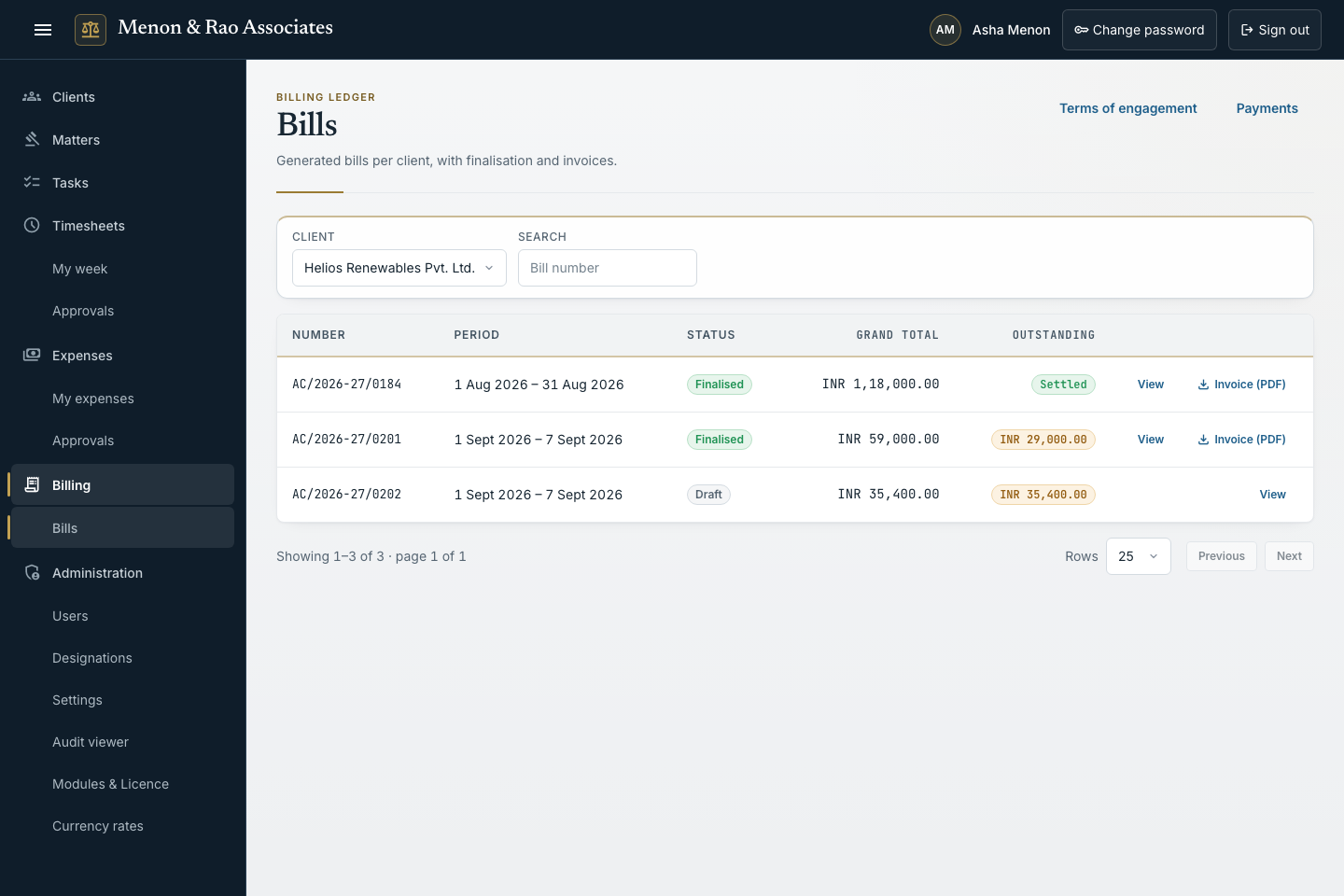
Terms of engagement per client and matter — fixed, hourly, or hybrid with rates by designation and fixed amounts by task. Bills draw only from approved time and approved disbursements. Finalised invoices are write-once, numbered by financial year, and rendered to PDF and DOCX.
Tax invoice
AC/2026-27/0184
| Particulars | Rate basis | Hours | Amount ₹ |
|---|---|---|---|
| Drafting and settling written statement | Partner | 6.5 | 117,000 |
| Conference with client and instructing solicitor | Partner | 2.0 | 36,000 |
| Research on limitation and amendment | Associate | 11.5 | 74,750 |
| Appearance — NCLT, Mumbai (26 & 27 Aug) | Fixed fee | — | 90,000 |
| Professional fees | 317,750 | ||
| Disbursements (travel, filing, court fees) | 14,300 | ||
| CGST @ 9% | 29,884 | ||
| SGST @ 9% | 29,884 | ||
| Invoice total | 391,818 | ||
| Less TDS @ 10% u/s 194J (withheld by client) | −31,775 | ||
| Expected receipt | 360,043 | ||
What may be switched on, firm by firm
A small core, and modules you license when you need them.
Core is always installed: people, permissions, settings, audit, notifications and file storage. Everything else is licensed per firm. A five-person practice running only timekeeping and a hundred-lawyer firm running the whole catalogue are the same software.
Core
coreUsers, designations, permissions, firm branding, settings, audit trail, notifications and file storage. Present in every installation.
Clients
licensedClient master with contacts and billing entities, per-client GST treatment and TDS applicability.
Read moreMatters
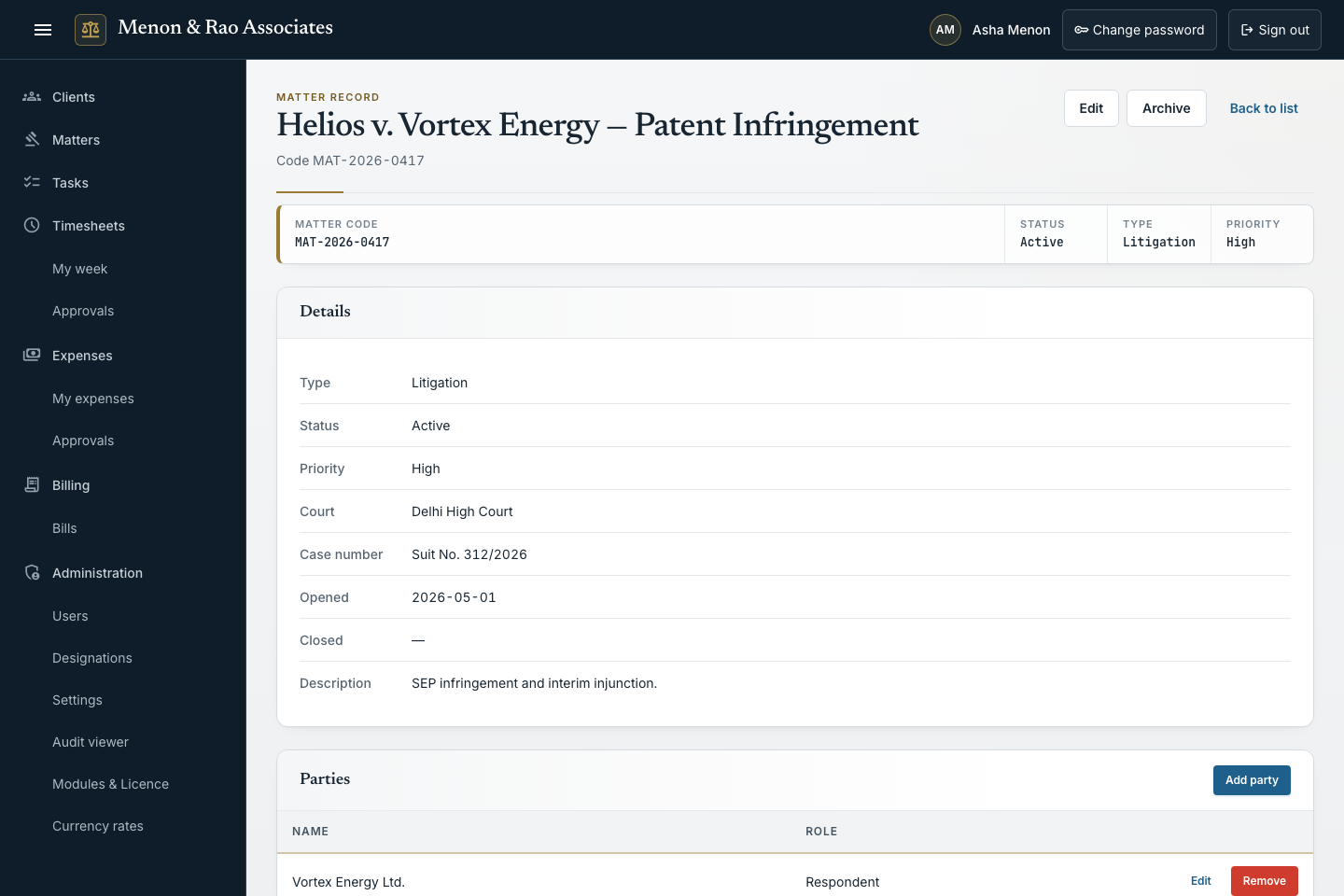
licensedMatter type, court, case number, opposing party and hearing dates — with configurable status and priority lists.
Read moreTasks
licensedA task catalogue plus per-matter assignments with assignee, supervisor and due dates.
Timesheets
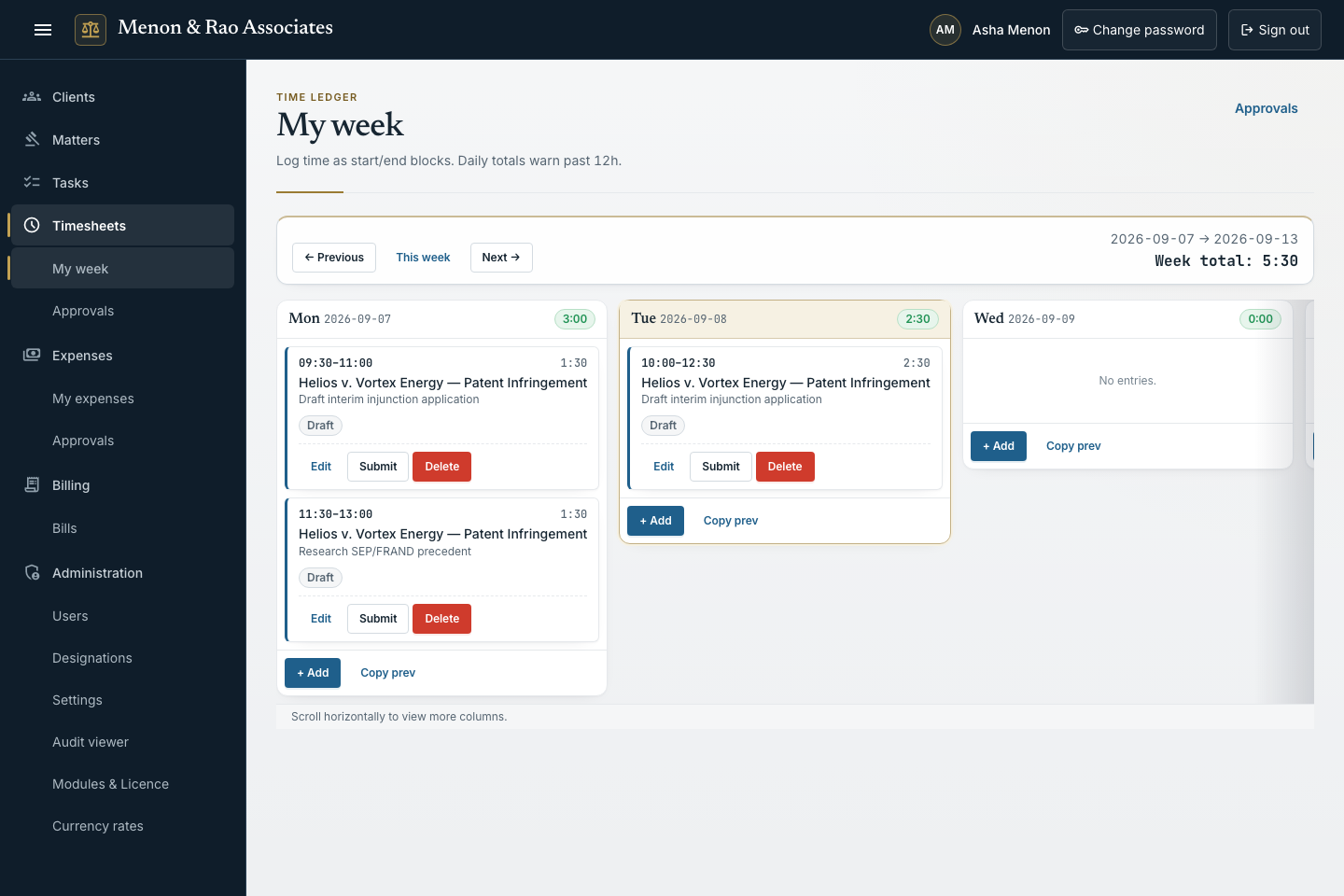
licensedWeekly entry grid with overlap validation, an approval queue, entries that lock once approved, and a reminder job.
Read moreExpenses
licensedDisbursement capture with receipt attachments, a billable flag and an approval queue.
Billing
licensedTerms of engagement, bills raised from approved time and expenses, GST, TDS-aware receipts, FY numbering, PDF and DOCX invoices.
Read moreRetainer
licensedPre-paid wallets per client or matter, a full ledger, replenishment on finalised bills and a low-balance scan.
Read moreDocuments
licensedA central document store per client and matter with versioning and permission-aware access.
Read moreReports
licensedA parameterised report runner with Excel and PDF export and scheduled email delivery. Modules contribute their own reports.
Where the software actually lives
Privacy is a deployment decision, not a policy page.
Client confidence, conflict information and unbilled work product are the three things a firm cannot afford to place in a pool it does not control. So AntChambers does not pool them.
- One installation per firm. Its own server, its own database, its own files, its own backups.
- Offline licensing. Which modules you run is carried in a signed file the installation checks by itself. Nothing phones home to authorise your work.
- Your address, your certificates. It answers on an address the firm chooses, secured by the firm’s own certificates.
- A complete audit trail. Every change is captured at the data layer, with soft deletes, and exported as CSV when someone asks who changed what.
A customer installation
practice.yourfirm.com
- runs onyour server
- databaseyours
- filesyour storage
- updateswhen you choose
- reaches usnever
antchambers.com is where we sell it. It is not where your firm’s data goes.
Indian practice, by default — never by assumption
Built for how Indian firms actually bill.
- GST that behaves. Tax lines with SAC codes, reverse charge, export and exempt treatment set per client, and an invoice heading that changes when the supply is untaxed.
- TDS-aware receipts. Record what the client actually paid after withholding, and keep the outstanding figure true.
- Financial-year numbering. Bill numbers roll on 1 April with a prefix you choose, not one we hardcoded.
- Retainers as a ledger. Pre-paid wallets per client or matter, drawn down by finalised bills, with a low-balance scan that tells you before the money runs out.
- Matter fields that exist in litigation. Court, case number, opposing party, hearing dates and matter type — not a generic "project".
- Money as money. Stored to two decimals with a currency, never as a floating-point number, with one tested type doing all the arithmetic.
- Multi-currency when you need it. Foreign-client engagements bill in their currency and consolidate in yours.
- Your name on it. Firm name, logo, address, GSTIN, financial-year convention and timezone are settings, and the login screen carries your mark.
Bringing a firm live
Four steps, not a four-month programme.
Provision a server
A modest machine inside your network, or with whichever hosting provider you already use. Everything it needs ships in the same bundle, or it uses what your IT people already run.
Install with your licence and your branding
One installer run, with the signed licence file naming your modules and a configuration file carrying your firm name, logo, GSTIN and financial-year convention. It is ready to use when it finishes.
Import what you already have
Clients, matters, people and rates come in first. Historic time and bills are imported where the source data supports it, so opening balances are real rather than typed.
Go live one module at a time
Most firms start with matters and timekeeping, let a full month settle, then switch on billing for the following cycle. Adding a module later is a licence update, not a migration.
Questions partners ask before the second meeting
Straight answers.
Is this software as a service?
No. Each firm gets its own installation — its own server, its own database, its own licence. Nothing of yours sits in a table beside another firm’s, and there is no service of ours that has to be running for your firm to work.
Can it run with no internet connection?
Yes. Your licence is a signed file the installation checks by itself, so nothing has to be confirmed over the internet. A firm running on its own hardware, with no connection to the outside world at all, is a supported arrangement rather than a workaround.
We only want timekeeping right now. Can we add billing later?
That is the design. Modules are switched on by an updated licence, not different software. Enabling Billing later is a configuration change; the code was always there and was always tested.
What happens to a module we have not licensed?
It simply is not there. No screens, no menu entries, nothing running in the background, and nothing for anyone to stumble into by accident.
Does it handle GST and TDS properly?
Yes — GST tax lines with SAC codes, per-client treatment for reverse charge, export and exempt supply, configurable rounding, and TDS-aware receipt recording so an invoice and the money actually received reconcile.
Who owns the data?
The firm does, without qualification. It sits on infrastructure the firm controls, and it can be backed up, moved or exported by the firm at any time.
See it against your own matters
A working demo takes about forty minutes. Bring a real fee note and a real timesheet week — we would rather show you the awkward parts than the polished ones.